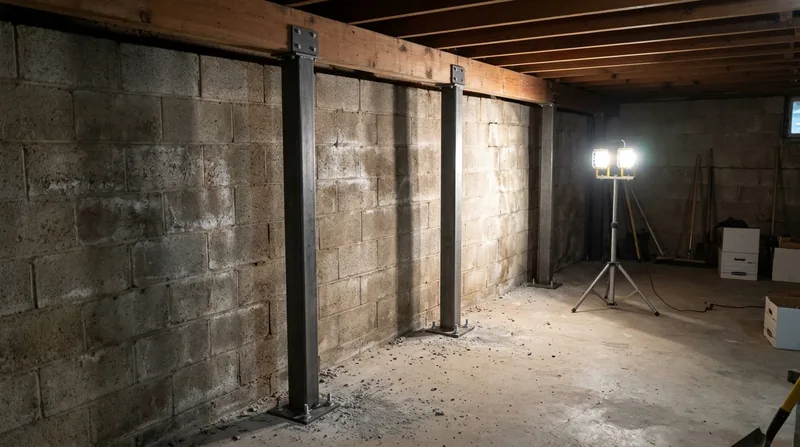




Bowing Wall Repair in Tulsa: Stop the Movement Before It Gets Worse
If you have a basement wall that is leaning inward, cracking horizontally, or bulging in the middle, you are dealing with bowing wall repair in Tulsa, and the clock is running. Tulsa sits on expansive clay over Pennsylvanian shale and sandstone. That clay swells hard after every spring thunderstorm and shrinks in the July drought, and it pushes against old brick, stone, and block foundation walls in Maple Ridge, Brookside, Swan Lake, and Florence Park. The 1910s to 1940s Tudor and Craftsman homes in those neighborhoods have full or partial basements, and many of those walls are past 90 years old. Out south and east, 1950s to 1970s brick ranches in Sand Springs and Broken Arrow show the same lean when a downspout dumps water at the footing for two decades. We do not guess at a repair. We read the wall, check the soil, and match the fix to the movement. Start with a free basement inspection if you are not sure what you are looking at.
Why Bowing Walls Are Common in Tulsa's Clay and Old Brick Basements
Tulsa's dominant failure mode is hydrostatic pressure from saturated clay. When the soil around a foundation takes on water after a heavy spring storm, it expands and pushes inward on the wall. The wall bows at mid-height, the mortar joints open on the inside face, and you get a horizontal crack near the frost line. In the older central neighborhoods, the brick and stone walls were never designed for that kind of lateral load. In the 1990s to 2020s brick subdivisions out in Jenks, Bixby, and Owasso, most homes sit on slab, so bowing walls show up mainly on custom and hillside builds where a full basement was cut into the slope. The signs to watch for:
- A visible inward lean when you sight down the wall from one corner.
- Horizontal cracking in the middle third of the wall, often with stair-step cracks at the ends.
- Doors and windows that stick more in wet spring weather than in dry summer.
- White efflorescence powder on the block, which means water is moving through the wall.
- Previous patching that has cracked again, a sign the pressure was never relieved.
If you see any two of those together, get the wall looked at before the next rainy season. For the official word on structural permits in the city, check the City of Tulsa Development Services before any structural work starts.
Key info: A 1920s brick basement wall in Maple Ridge that has bowed two inches is a different repair than a 1960s block wall in Sand Springs that has moved half an inch. We measure the movement and check the soil before we quote a fix.
How We Repair a Bowing Wall in Tulsa: Stabilize First, Then Relieve the Pressure
Bowing wall repair is not one product. We match the method to the severity of the movement and the soil load behind the wall. A wall that has moved less than an inch and is not cracking may only need carbon fiber straps to stop further movement. A wall that has moved two inches or more, or one that is rotating at the top, usually needs wall anchors or steel I-beams. We also look at the water. If the clay is staying saturated because a downspout dumps at the corner, the repair will not hold. Here is how a typical job runs:
- We inspect the wall, measure the lean, and check for horizontal and stair-step cracking.
- We check the exterior grade, downspouts, and window wells to find where the water is coming from.
- We recommend the right system: carbon fiber straps, wall anchors, or steel I-beams, sized to the load.
- We pull the permit if the work is structural, since rules vary by jurisdiction and the city has the final say.
- We install the system, then correct the water source so the clay stops swelling against the wall.
The repair stabilizes the wall. Relieving the pressure is what keeps it stable. That second step often means an exterior basement waterproofing scope or a footing drain correction, and we tell you plainly when that is the case.
Key info: In Broken Arrow, a 1970s ranch had a block wall bowing an inch and a half because a downspout had discharged at the same corner since the house was built. We anchored the wall and extended the discharge line. Two years later the wall has not moved.
Bowing Wall Repair Methods We Use in the Tulsa Metro
Each method does a different job. Some stop movement, some pull a wall back, and some do both. We pick based on how far the wall has moved, how tall it is, and what the soil is doing behind it.
| Approach | Description | Best for |
|---|---|---|
| Carbon fiber straps | Wide straps bonded to the inside face of the wall and anchored top and bottom. | Walls that have moved less than an inch with no major cracking. |
| Steel I-beams | Vertical steel beams set against the wall and tied into the floor and footing. | Tall walls and heavier loads where straps alone are not enough. |
| Wall anchors | Plates on the inside wall tied to anchors buried in stable soil outside. | Walls that have bowed two inches or more and need to be pulled back. |
| Drainage correction | Grading, downspout extensions, and footing drain work to stop the clay from staying wet. | Any bowing wall where water is the driver, which is most of them. |
Most Tulsa jobs combine two of these. The structural system stops the movement, and the drainage work removes the cause.
Bowing Wall Repair Cost in Tulsa: What to Expect
Bowing wall repair in Tulsa starts at $600 for a single carbon fiber strap on a short, lightly loaded wall. From there, the price climbs with the length of the wall, the number of straps or anchors, whether steel beams are needed, and how much drainage correction goes with it. A typical anchored wall on a 1920s brick basement in Brookside runs well into the thousands, and a full wall with steel beams and exterior drainage can go higher. The biggest cost driver is not the product. It is how far the wall has moved and whether the water problem is fixed at the same time. Get two or three written estimates, and make sure each one says what is being installed and whether drainage is included. Our full pricing overview breaks down the ranges we see.
Bowing Wall Repair Near Me: How to Choose a Tulsa Contractor
When you search for bowing wall repair near me, you will get a mix of general foundation firms, waterproofing specialists, and out-of-town crews. Ask three things before you sign anything. First, confirm the company is licensed and insured and can show you a certificate. Second, get more than one estimate and compare what is actually being installed, not just the bottom line. Third, ask who pulls the structural permit, because the city requires one for most foundation repair and the rules vary by jurisdiction. A contractor who cannot answer those questions clearly is not the one you want. You can contact us for a free estimate and we will walk you through it.
Key info: Ask for references from homes built in the same era as yours. A fix that works on a 2010 slab home in Bixby is not the same fix a 1930 brick basement in Florence Park needs.
Bowing Wall Repair in Tulsa: Pricing Guide
| Service | Price | Details |
|---|---|---|
| Carbon fiber strap repair | Starting at $600 | One strap on a short wall with minor movement, includes surface prep and bonding. |
| Wall anchor system | Starting at $2,400 | Anchors and interior plates for a wall bowed two inches or more, priced per anchor. |
| Steel I-beam stabilization | Starting at $3,800 | Vertical beams tied into floor and footing for tall or heavily loaded walls. |
| Complex or large-scale job | On estimate | Full wall with drainage correction needs an on-site look before any number is given. |
| Travel | Included | In Tulsa and surrounding areas, no separate call-out or mileage fee. |
| Estimate | Free | Response within 24h at (918) 992-3422, no obligation to book. |
Indicative pricing, the exact cost depends on square footage, finish, and site access. Free personalized estimate within 24h at (918) 992-3422.


